Torque sensor or cadence sensor: Which is better for an e-bike?

Torque sensor or cadence sensor: Which is better for an e-bike?
The riding experience of an e-bike depends on more than just the motor and battery. The sensor also plays a crucial role: it influences when the motor provides assistance, how strong the assistance is, and how natural the e-bike feels to ride. In this guide, we explain the differences between torque sensors and cadence sensors and, using the EVERCROSS EK25 and EK6 Ultra as examples, show what to consider when choosing one.

When buying an e-bike, people often focus first on motor power, battery capacity, and range. But anyone who actually compares different e-bikes quickly realizes: Two e-bikes with similar technical specifications can feel completely different when riding.
An important but often underestimated factor is the sensor.
Why is the sensor so important on an e-bike?
An e-bike doesn't simply work on the principle of "switch on the motor and deliver continuous power." As soon as you start pedaling, the system has to recognize what you're doing and provide the appropriate level of motor assistance.
This is exactly where the sensor comes into play. It provides important information about your pedaling motion, which is then processed by the drive system.
The sensor used can therefore have a significant impact on the driving experience:
- How smoothly does the motor assistance engage when starting off?
- How quickly does the e-bike react on inclines?
- How consistent does the support feel on flat stretches?
- How does the assistance change when you apply less force to the pedals?
- Does the e-bike feel like a bicycle with assistance – or more like the motor is doing the riding?
What is a torque sensor on an e-bike?
A Torque sensor measures the force you apply to the pedals when you pedal.
This allows the system to not only recognize, that you step, but also, how hard you kick.
"How hard do you kick?"
The torque sensor detects the actual pedaling force and thus enables dynamic adjustment of the motor support.
Driver and engine work together
If you increase your pedaling power, the level of assistance can increase accordingly. If you pedal more easily, the level of assistance can be adjusted.
The big advantage: The motor assistance is more closely aligned with your own pedaling power.
Especially during daily commutes, city driving or on varying routes, this dynamic support can contribute to a particularly natural driving experience.
What is a cadence sensor on an e-bike?
A Cadence sensor It primarily detects whether and how the driver is pedaling.
Unlike a torque sensor, the actual pedaling force applied is not the primary focus here. As a result, the motor assistance can be more consistent or more pronounced, depending on the system and assistance level.
However, this doesn't mean that a cadence sensor is inherently bad. For riders who prefer simple and direct electric assistance and primarily use their e-bike for short trips around town, such a system can be quite useful.
Torque sensor vs. cadence sensor: What's the difference?
The fundamental differences can be summarized as follows:
| Comparison | Torque sensor | Cadence sensor |
|---|---|---|
| What is being recorded? | Traction force | Pedaling motion / cadence |
| Type of support | Dynamic adjustment to pedaling force | Support depends on the detected pedaling action |
| Driving experience | Natural and sensitive | Direct and uncomplicated |
| gradients | More precise adjustment to the force required | Support is more dependent on the chosen level. |
| Daily life / Commuting | Very well suited | Well suited |
| Longer tours | Very well suited | Well suited |
| Control while driving | sensitive | Easier |
Why does a torque sensor feel more natural?
"Natural riding feel" is one of the most common terms used when discussing e-bikes with torque sensors. But what does that actually mean?
The crucial point is: The motor assistance can adapt to your own pedaling power.
When starting off: easier to control
When starting off, you don't normally pedal with maximum force immediately. A torque sensor can adjust the assistance to the actual pedaling power, thus enabling a more controlled transition to motor support.
On the mountain: Support tailored to the effort required
As soon as the terrain rises, the rider often automatically increases their pedaling force. A torque sensor can detect this change and adjust the motor assistance accordingly.
On flat stretches: drive relaxed and at a steady pace
On level roads, less assistance is often needed. If the pedaling force decreases, the motor assistance can adjust accordingly. This promotes a harmonious interaction between rider and drive system.
Why do the EK25 and EK6 Ultra use a torque sensor?
A sensor is not just a technical detail on a data sheet. On an e-bike that is used daily, it directly influences the riding experience.
Both the EVERCROSS EK25 as well as the EVERCROSS EK6 Ultra They rely on an intelligent torque sensor. This allows the motor assistance to react to the rider's pedaling force and support a harmonious riding experience when starting, accelerating and on different types of terrain.
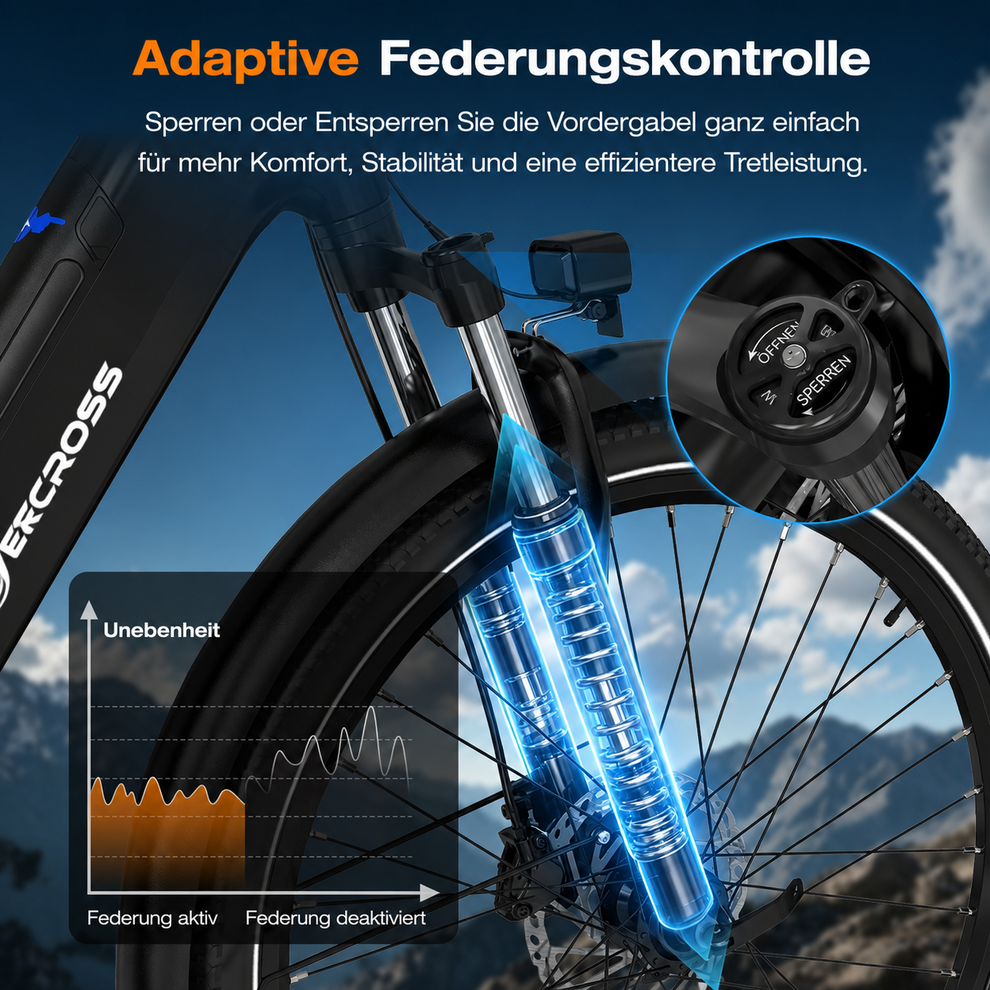
The EK25 combines this concept with a 250W rear motor, a 468Wh battery, Shimano 7-speed gear system, hydraulic disc brakes, suspension fork and luggage rack.
The EK6 Ultra takes the battery a step further: The removable 48V 18Ah battery offers 864Wh of capacity and is designed for longer rides. It also features 20 x 4.0-inch fat tires, a 250W motor, Shimano 7-speed gears, and a suspension fork.
Two e-bikes with torque sensors – which one suits you better?
Both models are part of the current Bike to School Action. The main differences lie in the design, battery, tires, and intended use. This allows you to choose the model that better suits your everyday life.

EVERCROSS EK25

EVERCROSS EK6 Ultra
* The actual range of the EK6 Ultra depends on factors such as rider weight, terrain, assistance level, weather and riding style.
Which model suits your everyday driving needs?
If you're looking for a comfortable e-bike for your daily commute, city trips, and classic everyday tours, this is the one. EK25 a particularly well-balanced option.
If, on the other hand, you value a larger battery, wide 20 × 4.0-inch fat tires and a particularly long range, this offers EK6 Ultra More reserves for longer journeys and different surfaces.
- EK25: A comfortable all-rounder for everyday life, commuting and city use.
- EK6 Ultra: Fat-Tire e-bike for greater range, stability and longer tours.
- Both models: Intelligent torque sensor for a natural driving feel.
- Bike to School: Both models are part of the current promotion.
Ready for your next ride?
A new school year means a new beginning – and perhaps a new way of getting around. If you're looking for an e-bike for your daily commute, city trips, or weekend tours, now is a great time to discover the perfect EVERCROSS model.
The current Bike to School campaign includes, among other things, the EVERCROSS EK25 and that EVERCROSS EK6 Ultra at the center. With the promotional code EV100 You can save €100 on participating models.
Is a torque sensor automatically better?
The answer is not simply "yes" or "no".
Both sensor types have their own areas of application. Those who prefer simple and direct electrical assistance can be very satisfied with a cadence sensor.
If, on the other hand, you value a natural driving feel, finer power modulation, dynamic support and a harmonious interplay between driver and engine If you're installing something, a torque sensor is particularly interesting.
That is precisely why both the EVERCROSS EK25 as well as the EVERCROSS EK6 Ultra on an intelligent torque sensor.
FAQ
Ready for your next ride?
Discover two EVERCROSS e-bikes with torque sensors and find the model that best suits your everyday life.
Discover EK25 → Discover the EK6 Ultra →